The Four Principles
Connect your domains. Enable your teams. Persist your decisions. Ground it all in risk.
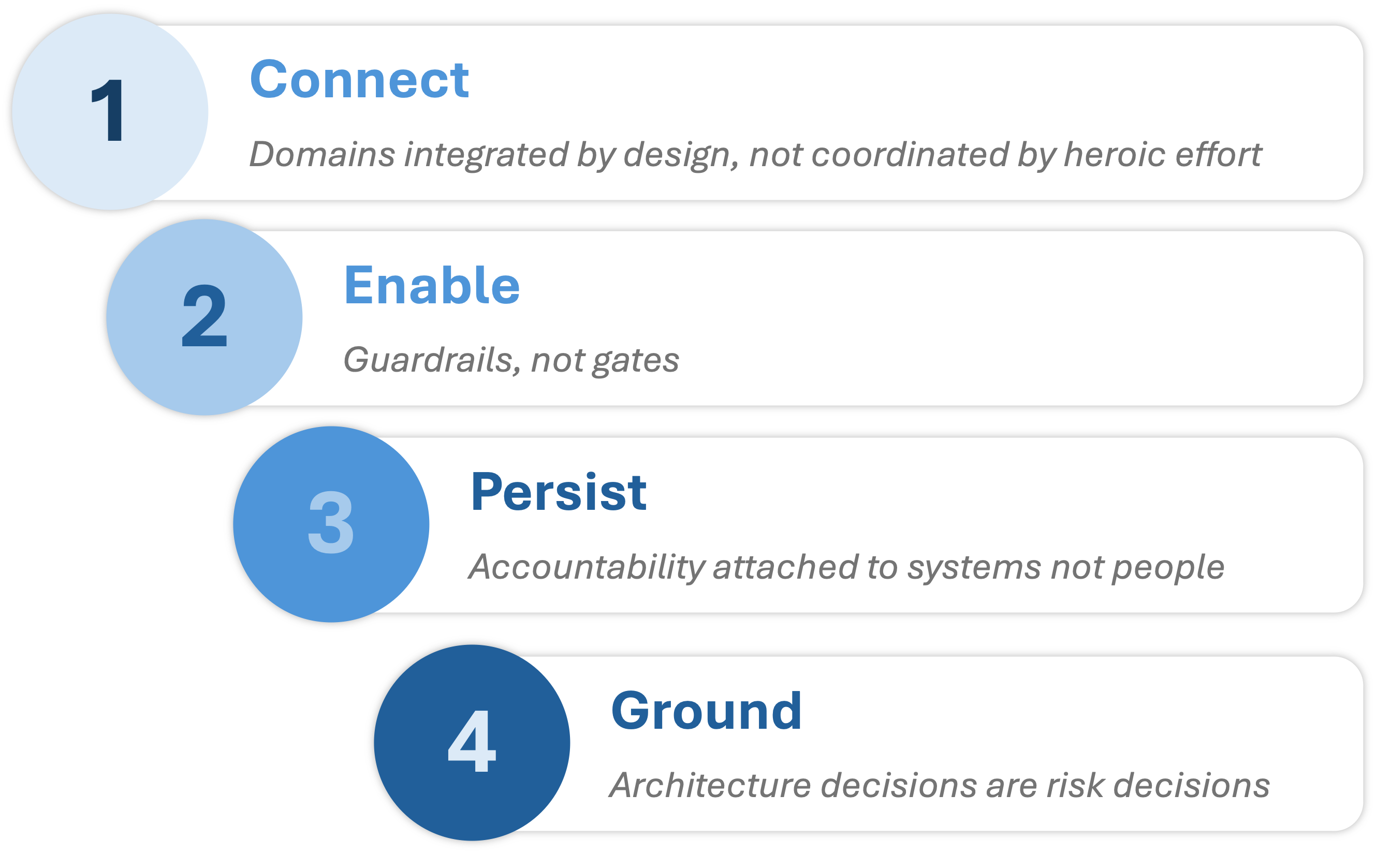
1. Connect
Domains integrated by design, not coordinated by heroic effort
The architecture domains exist for good reasons. Deep specialisation enables genuine expertise. Focused accountability creates clarity. Manageable scope prevents overwhelm. Professional communities develop around domain boundaries.
The problem isn't that domains exist. It's that they don't connect.
A business architect defines capabilities that should drive technology investment — but the connection happens through documents in SharePoint, not systematic traceability. A data architect establishes governance frameworks — but security architects weren't involved in defining classification requirements. Decisions made in one domain create downstream impacts in others that only surface during implementation.
Connected Architecture builds integration into how the framework operates:
Strategy → Capability → Information → Technology → Solution
Business priorities flow to capability investment decisions. Capability investments drive information requirements. Information requirements shape technology choices. Technology choices constrain solution design. Each step traces to the next.
Security embedded at every layer
Security isn't a review gate at the end. Security guardrails inform decisions throughout the flow. Security architecture integrates with every domain — not as approval authority, but as enabling constraint. When security is designed in from the start, it stops being the team that says no and becomes the team that shows you how to get to yes.
Cross-domain visibility without cross-domain bureaucracy
You don't need architects from every domain in every meeting. You need explicit handoff mechanisms and shared artefacts that preserve context. When the business architecture output becomes the information architecture input, the intent behind business decisions actually translates to technical design.
Innovation assessed against architecture readiness
Before innovation initiatives scale to production, they're assessed against data readiness, integration maturity, and security posture. Experiments can proceed with lower readiness — that's the point of experiments. But production deployments require foundation. This stops the pattern where proof-of-concept projects succeed in isolation and then fail at scale because the architecture wasn't ready.
The goal isn't architecture by committee. It's architecture where each domain's work informs and constrains the others appropriately — and where nobody gets surprised by cross-domain impacts late in delivery.
2. Enable
Guardrails, not gates
This is where most architecture governance goes wrong.
Traditional approach: EA adds gates. More reviews, more approvals, more checkpoints. What happens? Architecture becomes resented, bypassed, and eventually irrelevant. Teams find workarounds because they've got deadlines to hit. The architecture function produces documentation that nobody reads and approvals that everybody routes around.
The alternative isn't removing all constraints — that just creates fragmentation, tech debt everywhere, and architectural drift. Three years later you've got a mess that nobody fully understands.
The answer is guardrails, not gates.
| Gates | Guardrails |
|---|---|
| Require someone to say yes | Define the playing field upfront |
| Create bottlenecks | Enable autonomy within boundaries |
| Drive workarounds | Make compliance self-service |
| Generate relationship friction | Turn deviation into conversation, not crime |
Inside the guardrails: Just get on with it. No approval needed. You're playing within the boundaries that everyone agreed on. The guardrails embody the organisation's risk appetite, technology direction, and architectural principles. If you're inside them, you're already aligned.
Outside the guardrails: Not an automatic no. It's a conscious deviation that needs a conversation. Sometimes you need to colour outside the lines — new technology that isn't on the radar yet, an integration pattern that doesn't fit the standard, a timeline that requires taking on debt. That's fine. But let's make sure we understand why and what it means.
The shift in mindset is critical. Traditional architecture asks: "Did you get approval?" Guardrail-based architecture asks: "Did you stay inside the lines, or did you consciously choose to step outside?" Both require accountability. Only one creates bottlenecks.
What guardrails cover:
- Strategic guardrails from business and enterprise architecture — capabilities we're investing in, capabilities we're divesting from, business outcomes that matter this cycle
- Technology guardrails from technology architecture — technology radar positioning, integration patterns, hosting and deployment standards
- Data guardrails from information architecture — data domains and ownership, master sources, classification and handling requirements
- Security guardrails from security architecture — non-negotiable controls, risk-based tiering for scrutiny levels
Guardrails are living, not static. They get created when strategic decisions are made, when patterns of problems emerge, when new compliance requirements hit, when repeated questions signal a gap. They get reviewed on a regular cadence — annually for strategic, quarterly to six-monthly for domain. They get retired when no longer relevant, superseded, otherwise they're causing more harm than good.
Not everything needs the same scrutiny. A new integration pattern touching core customer systems needs more oversight than a team implementing a standard pattern they've used before. Tiered oversight matches scrutiny to risk:
| Tier | What It Covers | Oversight Level |
|---|---|---|
| Tier 1 — High Risk | New technology, new patterns, core systems, significant investment, regulatory impact | Active EA involvement at decision points |
| Tier 2 — Medium Risk | Extends existing patterns, moderate complexity, internal impact | Lightweight checkpoint + async review |
| Tier 3 — Low Risk | Standard patterns, low complexity, well-understood domain | Self-certification against guardrails |
The goal is governance that teams actually want to engage with. Not because they have to, but because it's genuinely useful. When the guardrails are clear, current, and sensible, staying inside them becomes easier than working around them.
3. Persist
Accountability attached to systems, not people
Here's a fundamental insight that most architecture functions miss: people move on, but systems persist.
Architects leave. Projects end. Contractors finish their contracts. Reorganisations shuffle teams. The person who made the decision, understood the trade-offs, and knew the context — they're gone. But the system they shaped? That's still running. Still accumulating technical debt. Still creating integration challenges. Still needing maintenance and evolution.
If architecture decisions live in architects' heads, you lose them when the architects leave. If decisions are buried in project documentation that nobody will ever look at again, you've lost them even while the people are still around.
Connected Architecture attaches accountability to the thing, not the person.
The Architecture Passport
Every system or product has an Architecture Passport — a living record that travels with it:
| Field | What It Captures |
|---|---|
| Current state summary | What actually exists now |
| Key decisions and rationale | Why it was built this way |
| Known debt and status | Outstanding trade-offs |
| Guardrail compliance/deviations | Where it stands |
| Integration points and dependencies | What connects to what |
When architects touch the system, they update the passport. When they leave, the passport stays. When the next team picks it up, they can understand what they're inheriting without a six-month archaeology project.
Decision Records
Every significant decision gets documented. Not a 50-page artefact — something you can complete in 15 minutes that captures the essentials:
- What decision was made?
- What options were considered?
- What guardrails does this touch?
- What debt does this introduce?
The point isn't bureaucracy. It's traceability. When someone looks at this system in three years, they can understand why it was built this way. When patterns of similar decisions emerge, you can spot them. When a decision turns out to be wrong, you can understand the context that led to it.
Technical Debt as a First-Class Citizen
Technical debt isn't hidden or shameful — it's a managed backlog item. Sometimes taking on debt is the right call. You've got a deadline. The perfect solution would take three months. The good-enough solution that creates some debt takes three weeks. That's a legitimate trade-off.
But debt needs to be:
- Recorded — in the debt register, attached to the system
- Estimated — rough effort to remediate
- Owned — someone's name attached
- Visible — to enterprise architecture and anyone inheriting the system
This changes the conversation from "you broke the rules" to "you made a trade-off — let's make sure there's a payback plan."
Untracked debt is unmanaged risk. It accumulates invisibly until it creates a crisis. Tracked debt is a conscious choice with a path to resolution.
Handover as Required Deliverable
Project close requires handover. Not optional. Not informal. Not "I'll write that up when I get a chance."
- Decisions made and why
- Debt introduced and remediation estimate
- Guardrail deviations and justifications
- What the inheriting team needs to know
When this is a required deliverable, knowledge transfer actually happens. When it's optional, it doesn't.
4. Ground
Architecture decisions are risk decisions
Here's an insight that changes how you think about architecture governance: every architecture decision is a risk decision. Whether you acknowledge it or not.
Choosing a technology? You're accepting the risks of that vendor, that platform, that skill set requirement. Deviating from a standard? You're accepting the risks of inconsistency, maintenance complexity, knowledge fragmentation. Taking on technical debt? You're deferring risk to the future. Skipping security review? You're accepting vulnerability risk.
The question isn't whether architecture involves risk. It's whether you're managing that risk explicitly or pretending it doesn't exist.
Connected Architecture makes the risk dimension explicit.
Guardrails Embody Risk Appetite
When you set guardrails, you're really defining your organisation's risk appetite in architectural terms. The technology radar says "adopt" for certain platforms because the organisation has accepted the risks and decided the benefits outweigh them. The security guardrails mandate certain controls because the organisation isn't willing to accept the risk of operating without them.
Staying within guardrails means operating within pre-accepted risk boundaries. The risk assessment has already been done. The trade-offs have already been weighed. Teams don't need to re-evaluate from first principles every time.
Deviations Are Risk Acceptances
When you step outside the guardrails, you're accepting additional risk. That's not automatically wrong — sometimes it's exactly the right call. But it needs to be conscious and appropriately authorised.
| Architecture Decision | Risk Treatment |
|---|---|
| Within guardrails, standard pattern | Pre-accepted (guardrails embody risk appetite) |
| Tier 3 deviation | Accepted by delegation (Solution Architect) |
| Tier 2 deviation | Accepted by domain (Domain Architect) |
| Tier 1 deviation | Requires formal acceptance (EA recommends, Risk Owner accepts) |
| Technical debt introduced | Deferred risk (logged, estimated, owned) |
| Technical debt untracked | Unmanaged risk (invisible, accumulating) |
The tiered oversight model isn't arbitrary — it's calibrated to risk. Higher-risk decisions get more scrutiny. Lower-risk decisions get more autonomy. The framework scales governance to actual risk, not to bureaucratic habit.
GRC Integration
Architecture doesn't operate in isolation from your broader Governance, Risk, and Compliance ecosystem. It's part of it.
- Risk Committee interface: Architecture risks escalate appropriately; risk appetite informs guardrails
- Compliance alignment: Guardrails incorporate compliance requirements — Essential Eight, ISM, PSPF, industry regulations, privacy legislation
- Audit support: Decision records and passports provide traceability for audit purposes
- Policy alignment: Architecture standards align with organisational policies
When to Escalate to Enterprise Risk
Not every architectural issue stays within architecture governance. Some situations require escalation:
- Deviation impacts compliance posture
- Debt remediation exceeds defined thresholds
- Deviation affects core or critical systems
- Multiple deviations creating a systemic pattern
- Security control gap being accepted
- Significant vendor risk being introduced
The architecture function doesn't own these decisions. But it does own surfacing them to the people who do.
Risk-Based Tier Assessment
The tier classification isn't guesswork. It's based on risk factors:
| Factor | Tier 1 (High Risk) | Tier 2 (Medium Risk) | Tier 3 (Low Risk) |
|---|---|---|---|
| System criticality | Core business, customer-facing, regulated | Supporting, internal, moderate impact | Peripheral, low impact |
| Data sensitivity | Protected, personal, classified | Internal, business-sensitive | Public, non-sensitive |
| Integration scope | Enterprise-wide, external parties | Multi-system, internal | Single system, isolated |
| Investment size | Above threshold (e.g., $500k+) | Moderate ($100k–$500k) | Below threshold (<$100k) |
| Technology novelty | New to organisation, unproven | New to team, proven elsewhere | Established, standard |
| Compliance impact | Regulatory requirement affected | Policy requirement affected | No compliance impact |
Grounding architecture in risk isn't about adding bureaucracy. It's about making explicit what's already implicit. Every architecture decision carries risk implications. The framework just makes sure you're seeing them clearly and managing them appropriately.
The Principles in Practice
Connect your domains. Enable your teams. Persist your decisions. Ground it all in risk.
These four principles work together.
Connection without enablement creates bottlenecks — domains talking to each other but requiring approval for everything. Enablement without persistence creates knowledge loss — fast decisions that nobody remembers the rationale for. Persistence without grounding creates false confidence — documented decisions that don't acknowledge their risk implications. Grounding without connection creates silos — each domain managing its own risks without cross-domain visibility.
The framework brings all four together into architecture that actually works in practice. Architecture that ships.
Ready to Get Started
XAF Connected Architecture | Developed by InnovateX Solutions