Tiered Oversight
Right scrutiny for right risk.
What This Component Does
Not everything needs the same level of architectural scrutiny. A new integration pattern touching core customer systems needs more oversight than a team implementing a standard pattern they've used before.
Traditional architecture governance often applies the same process to everything - same review board, same documentation requirements, same approval gates. The result? Either everything gets bogged down in heavyweight process, or teams learn to route around governance entirely because it's not worth the hassle.
Tiered oversight solves this by scaling governance to actual risk. High-risk decisions get active architecture involvement. Low-risk decisions within established patterns get self-certification. The middle ground gets lightweight checkpoints.
The goal isn't less governance - it's appropriate governance that teams actually follow because it makes sense.
The Three Tiers
| Tier | Risk Level | What It Covers | Oversight Level |
|---|---|---|---|
| Tier 1 | 🔴 High | New technology, new integration patterns, core systems, significant investment, regulatory impact | Active architecture involvement at key decision points |
| Tier 2 | 🟠 Medium | Extends existing patterns, moderate complexity, internal impact | Lightweight checkpoint plus async review |
| Tier 3 | 🟢 Low | Standard patterns, low complexity, well-understood domain | Self-certification against guardrails |
Tier 1 - High Risk
- Introducing technology new to the organisation
- New integration patterns or approaches
- Changes to core business systems or customer-facing platforms
- Significant investment (your threshold - often $500k+)
- Regulatory or compliance implications
- External party integration
- Enterprise-wide impact
- Architecture involvement from initiation
- Architect participates in design decisions
- Formal architecture review at key milestones
- Decision records required for all significant choices
- Architecture sign-off before major commitments
- Passport created and maintained throughout
- Solution Architect embedded or closely engaged
- Domain Architect consulted on domain-specific decisions
- Enterprise Architecture aware and providing strategic alignment input
- Business Sponsor accepts risk for deviations
Tier 2 - Medium Risk
- Extends or adapts existing patterns
- Moderate complexity within known domains
- Internal business impact (not customer-facing)
- Moderate investment ($100k-$500k typical)
- Multi-system integration using established patterns
- New capability on existing platforms
- Architecture checkpoint at initiation to confirm tier and identify guardrails
- Solution Architect available for consultation
- Async review of key decisions (doesn't block progress)
- Decision records for deviations from guardrails
- Passport updated at project close
- Solution Architect consulted as needed
- Domain Architect available for domain-specific questions
- Deviations logged and reviewed periodically
Tier 3 - Low Risk
- Standard patterns applied as documented
- Low complexity, well-understood domain
- Isolated impact, single system
- Below investment threshold (<$100k typical)
- No new technology or patterns
- No compliance implications
- Self-certification against relevant guardrails
- Team confirms alignment with standards
- Decision records only for conscious deviations
- Passport updated if system touched
- Delivery team self-certifies
- Architecture available if questions arise
- Deviations flagged in regular sampling
Assessing Which Tier Applies
Use these factors to determine the appropriate tier. If any factor suggests a higher tier, default to the higher tier.
Risk Factor Matrix
| Factor | Tier 1 (High) | Tier 2 (Medium) | Tier 3 (Low) |
|---|---|---|---|
| System criticality | Core business, customer-facing, regulated | Supporting, internal, moderate impact | Peripheral, low impact |
| Data sensitivity | Protected, personal, classified | Internal, business-sensitive | Public, non-sensitive |
| Integration scope | Enterprise-wide, external parties | Multi-system, internal | Single system, isolated |
| Investment size | Above threshold (e.g., $500k+) | Moderate ($100k-$500k) | Below threshold (<$100k) |
| Technology novelty | New to organisation, unproven | New to team, proven elsewhere | Established, standard |
| Compliance impact | Regulatory requirement affected | Policy requirement affected | No compliance impact |
| Reversibility | Difficult or costly to reverse | Moderate effort to reverse | Easily reversible |
| Skill availability | Requires skills we don't have | Stretches existing skills | Well within capability |
Tip
These criteria can be adjusted to suite your organisations risk appetite
Decision Tree
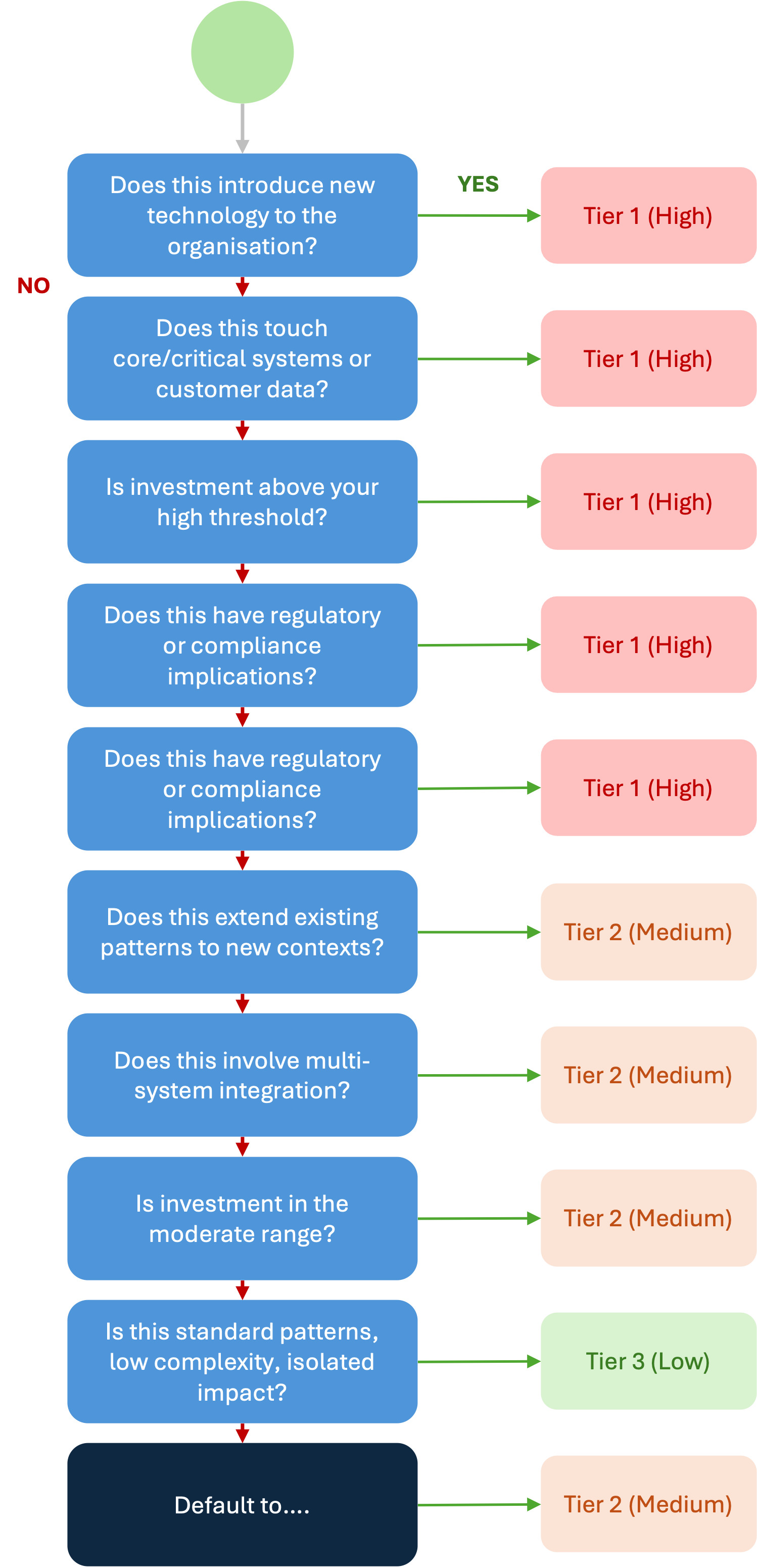
When in Doubt
If you're genuinely uncertain which tier applies:
- Default up, not down - Better to have oversight you don't need than miss oversight you do
- Ask architecture - A quick conversation can classify appropriately
- Start at Tier 2 - Reasonable middle ground while you assess further
- Document your reasoning - If the tier is later questioned, your rationale is on record
Tiered Oversight as Risk Management
Here's the insight that makes tiered oversight click: architecture decisions are risk decisions.
Every guardrail embodies a risk appetite decision. Every deviation is a risk acceptance. Every piece of technical debt is deferred risk. The tier model maps directly to how risk is managed.
Risk Treatment by Tier
| Architecture Decision | Risk Treatment | Authority |
|---|---|---|
| Within guardrails, Tier 3 | Pre-accepted risk | Self-certification |
| Within guardrails, Tier 2 | Pre-accepted risk | Lightweight checkpoint |
| Within guardrails, Tier 1 | Pre-accepted, verified | Architecture review |
| Deviation, Tier 3 | Accepted by delegation | Solution Architect logs |
| Deviation, Tier 2 | Accepted by domain | Domain Architect approves |
| Deviation, Tier 1 | Formal acceptance | EA recommends, Business Sponsor accepts |
Escalation to Enterprise Risk
Some situations escalate beyond architecture governance to enterprise risk management:
- Deviation impacts compliance posture (Essential Eight, PSPF, privacy legislation)
- Technical debt remediation exceeds defined thresholds
- Deviation affects core or critical systems
- Pattern of multiple deviations creating systemic risk
- Security control gap being accepted
- Significant vendor risk being introduced
Architecture doesn't own these decisions - but architecture does own surfacing them to people who do.
Decision Authority by Tier
Clear decision rights prevent bottlenecks and confusion. Everyone knows their lane.
Authority Matrix
| Decision Type | 🔴 Tier 1 | 🟠 Tier 2 | 🟢 Tier 3 |
|---|---|---|---|
| Within guardrails | Solution Architect confirms | Solution Architect confirms | Team self-certifies |
| Minor deviation | Domain Architect approves | Solution Architect logs | Solution Architect logs |
| Significant deviation | EA recommends, Sponsor accepts | Domain Architect approves | Domain Architect approves |
| Guardrail doesn't exist | EA defines guardrail | EA defines guardrail | Flag gap to EA |
| Guardrails conflict | EA arbitrates | EA arbitrates | Escalate to EA |
Escalation Triggers
Escalate to the next level when:
| Situation | Action |
|---|---|
| Decision is outside your authority | Escalate one level |
| Genuinely unsure of the right call | Ask for guidance |
| Stakeholders disagree | Escalate to common authority |
| Guardrails conflict with each other | EA arbitrates |
| Stuck for more than 2 days | Escalate rather than stall |
Escalation Path
Solution Architect
        │
        ▼
Architecture Working Group / CoE
      (peer review)
        │
        ▼
Domain Architect
        │
        ▼
Enterprise Architect
        │
        ▼
Business Sponsor / Architecture Authority
Implementing Tiered Oversight
At Project Initiation
Every initiative gets classified at initiation:
- Identify the scope - What systems, data, integrations are involved?
- Assess risk factors - Walk through the factor matrix
- Assign initial tier - Use decision tree or factor assessment
- Identify relevant guardrails - What boundaries apply?
- Confirm oversight approach - Who's involved, what checkpoints?
- Document in passport - Record tier and rationale
During Delivery
Tier determines ongoing engagement:
Tier 1:
- Architect attends key ceremonies (sprint planning, design sessions)
- Architecture review at each major milestone
- Decision records maintained throughout
- Regular check-ins with EA for strategic alignment
Tier 2:
- Architect available on-demand
- Checkpoint at design completion
- Async review of decision records
- Flag any tier reassessment needs
Tier 3:
- Team proceeds autonomously
- Self-certification at completion
- Architecture available if questions arise
Tier Reassessment
Tiers can change as understanding evolves:
- Scope expands to include core systems
- New technology becomes necessary
- Integration complexity increases
- Risk factors change
- Scope narrows significantly
- Approach simplifies
- Proven patterns now apply
- Risk factors decrease
Document tier changes in the passport with rationale.
Setting Your Thresholds
The tier boundaries in this document are examples. Set thresholds appropriate to your organisation.
Investment Thresholds
Consider:
- Your organisation's risk appetite
- Typical project sizes
- Where you want architecture involvement
| Org Size | Tier 1 Threshold | Tier 2 Range | Tier 3 Threshold |
|---|---|---|---|
| Small (<100 staff) | $100k+ | $25k-$100k | <$25k |
| Medium (100-500) | $250k+ | $50k-$250k | <$50k |
| Large (500+) | $500k+ | $100k-$500k | <$100k |
| Enterprise | $1M+ | $250k-$1M | <$250k |
System Criticality
Define what "core" and "critical" mean for your organisation:
- Core: Systems that directly deliver primary business value
- Critical: Systems where outage causes significant business impact
- Supporting: Systems that enable but don't directly deliver value
- Peripheral: Systems with limited business impact if unavailable
Data Sensitivity
Align with your data classification scheme:
- Protected/Classified: Regulatory protection, significant harm if disclosed
- Internal/Sensitive: Business sensitive, moderate harm if disclosed
- Public: No sensitivity, minimal harm if disclosed
Anti-Patterns to Avoid
| Anti-Pattern | Problem | Fix |
|---|---|---|
| Everything is Tier 1 | ❌ Architecture becomes bottleneck, teams route around | ✅ Trust the model, let Tier 3 self-certify |
| Everything is Tier 3 | ❌ No visibility, debt accumulates, coherence lost | ✅ Honest risk assessment, don't game the system |
| Tier gaming | ❌ Teams understate risk to avoid oversight | ✅ Sampling and audit, consequences for misclassification |
| Tier as punishment | ❌ Higher tier seen as distrust or penalty | ✅ Frame as risk management, not control |
| Static tiers | ❌ Tier never reassessed as initiative evolves | ✅ Built-in reassessment triggers |
| Unclear thresholds | ❌ Inconsistent tier assignment | ✅ Document and communicate thresholds |
| No Tier 3 | ❌ Everything requires architecture involvement | ✅ Define what "standard" looks like, trust teams |
Making It Work
Tiered oversight only works if:
- Tiers are honestly assigned - Gaming defeats the purpose
- Tier 3 is genuinely self-service - If teams still need approval, it's not Tier 3
- Thresholds are clear and communicated - No ambiguity about what triggers each tier
- Architecture is helpful, not just oversight - Teams should want involvement at higher tiers
- Sampling validates self-certification - Trust but verify
The goal is architecture engagement that scales to value and risk - not bureaucracy for its own sake.
Tiered oversight promise section · MD Copy
The Tiered Oversight Promise
Not everything matters equally. Tiered oversight makes that explicit.
- If you're Tier 3: Standard patterns, low risk, well-understood territory. Self-certify against guardrails and get on with it. Architecture trusts you to colour inside the lines.
- If you're Tier 2: More complexity, more integration, more at stake. A lightweight checkpoint — someone reviews your approach, asks a few questions, confirms you've thought it through. Then you proceed.
- If you're Tier 1: Core systems, significant investment, new territory, real risk. Active architecture involvement at decision points. Not blocking — enabling. Making sure the big choices get the attention they deserve.
The promise is proportionality. Governance scaled to stakes. Architecture attention concentrated where consequences are highest.
Teams doing routine work shouldn't wait for review. Teams doing critical work shouldn't go it alone.
Know your tier. Get the governance that fits.
XAF Connected Architecture | Developed by InnovateX Solutions